In short
- A suite for SMEs of every kind: one set of connected tools to set up a company, configure how it works, run it every day, and grow it with CRM, ERP, analytics and AI.
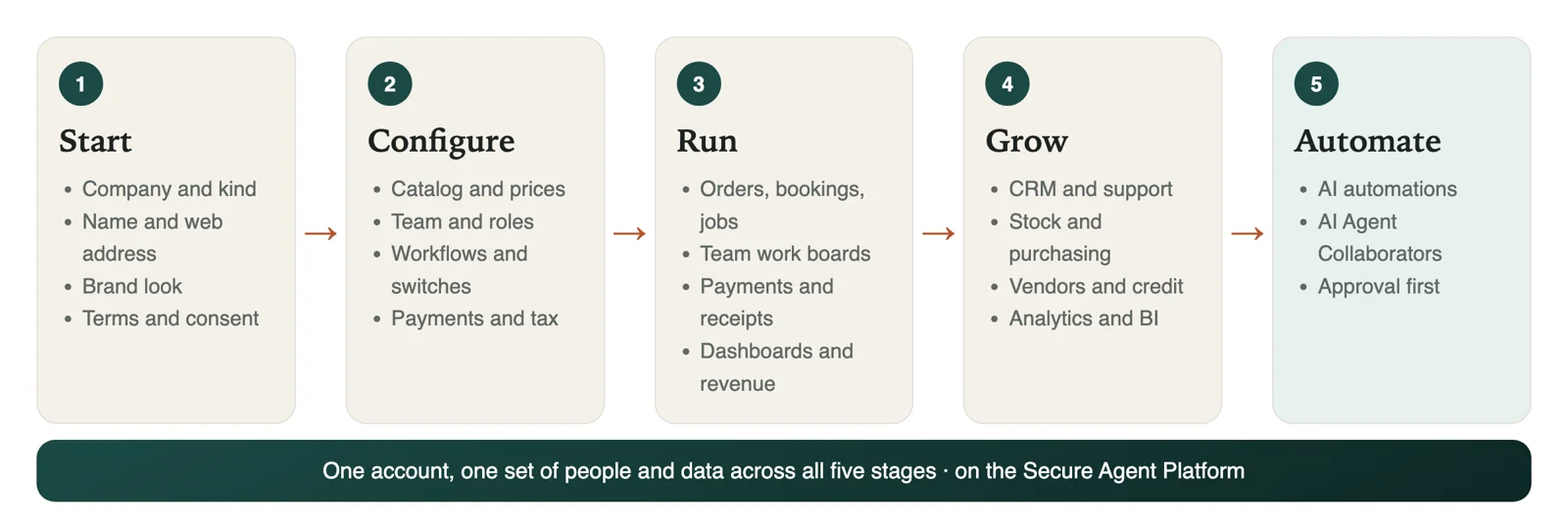
- The whole life of a business: Start (set up in five steps), Configure (catalog, team, workflows, payments, tax), Run (orders, bookings, jobs, payments, reports), Grow (CRM and ERP) and Automate (AI agents).
- One engine, many industries: a kind profile gives each industry its own screens, words and starter data, so a wholesaler sees price lists and credit, and a travel agent sees packages and deposits.
- On the Secure Agent Platform: ebz.app is the hosted edition; integrations and phone apps are other ways to use the same suite.
Why SMEs need a suite, not more apps
Small and mid-sized enterprises make up the large majority of businesses in Asia and employ most of the workforce. Yet most of them run on a patchwork: a website from one vendor, a marketplace or booking app that takes a commission, an accounting package the owner does not fully use, spreadsheets for stock and price lists, and WhatsApp for customers, suppliers and staff. Large companies solve this with ERP and CRM systems that cost a great deal, take months to set up, and need specialists to run.
The result for an SME is the same in every industry: data typed in several times, no single view of customers or stock, no time for growth, and dependence on platforms that own the customer relationship. Ebiz Suite brings the integrated approach of enterprise software to the scale of a five- or fifty-person business: set up in an afternoon, run from a phone, and extended module by module.
The business lifecycle Ebiz Suite covers
One suite, many kinds of business
A trading company, a travel agency and a repair service do very different work, but underneath they all have customers, a catalog of what they sell, people with roles, transactions that move through stages, payments, and reports. Ebiz Suite models that shared core once, and adds a kind profile for each industry: its own words, screens, steps and starter catalog. Choosing a kind at sign-up sets all of this up in seconds.
- Trading and wholesale: customer-specific price lists, quotations, sales orders, credit limits and terms, delivery notes.
- Travel and tours: packages and departures, seat inventory, bookings, itineraries, deposits and balances.
- Shops and e-Shops: products with variants and stock, delivery zones, pickup codes, returns, in-store scan and go, across many types of shop.
- Restaurants and cafes: menu with choices, table QR ordering, kitchen board with stations, delivery zones.
- Tuition and coaching: courses, batches, timetables, admissions with tests or approval, fees by plan, a family page.
- Lodges and homestays: rooms and rates, bookings, check-in, guest requests.
- Taxi and transport: trips, drivers, vehicles, fares and dispatch.
- Exporters: pro forma invoices, multiple currencies, shipping documents.
- Services and repairs: appointments, jobs and job cards, technicians, bills.
Each kind profile is checked against real businesses of that kind. The shared engine means each new kind reuses everything before it: sign-in, team roles, payments, tax, reports and security.
The modules
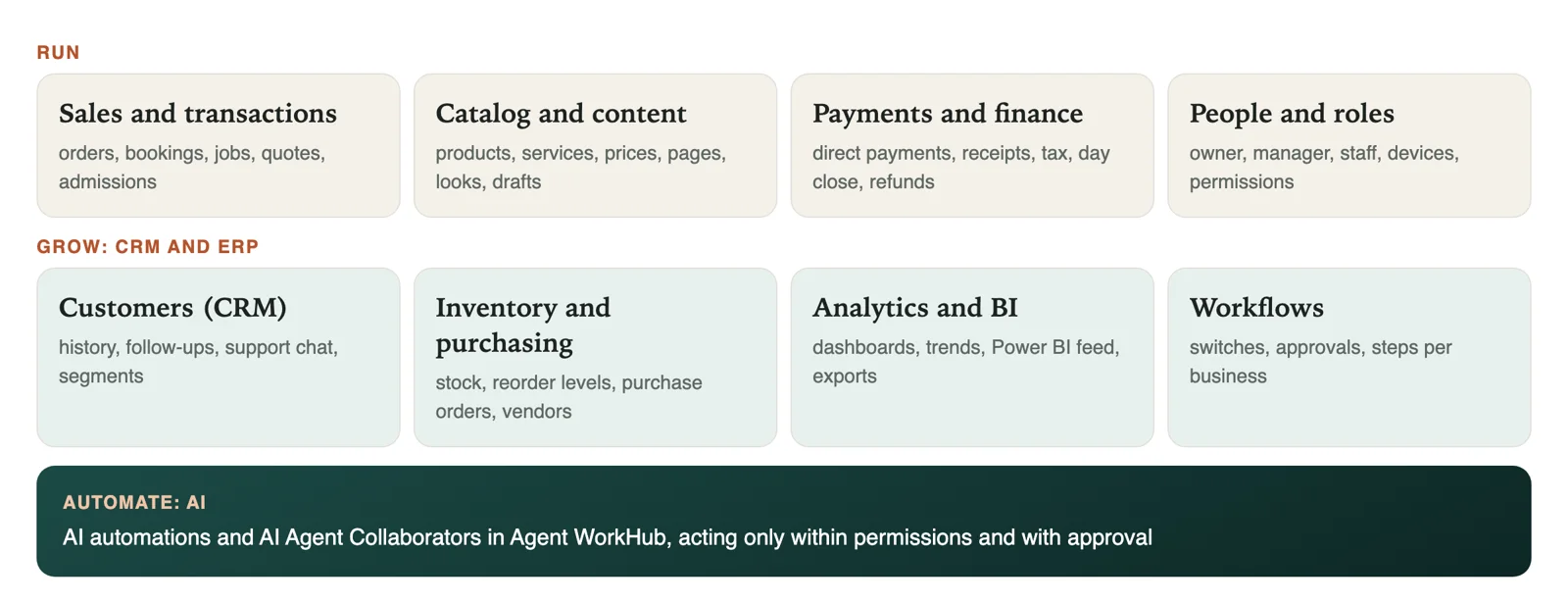
Behind the kinds sit the modules every business uses, in three layers: Run for daily operations, Grow for CRM and ERP, and Automate for AI.
Walking through the lifecycle with three businesses
The examples below use fictional businesses, the same samples that appear on ebz.app's own landing pages, to show how one suite serves very different work.
Start: set up a company in five steps
Configure: make the suite work the business's way
Next, the owner shapes the account. The catalog is imported from the existing Excel price list, with a dry run that shows every problem before anything changes. Customer-specific price lists and credit terms are set. Team members get roles: sales reps see their customers and create quotations, the warehouse sees what to pack, the accountant sees receipts and the day's file. Workflows are switches, not code: for example how customers order and pay, whether a sale needs approval, and which steps the team follows. Payment methods are switched on: here UPI and bank transfer to the company's own account. Every change is drafted first and published when ready.
Run: the daily operations
Every kind runs on the same pattern: a transaction (order, booking, job, admission) moves through clear stages on a work board, payments are recorded with who confirmed them, receipts carry the correct tax lines for the country, and the dashboard shows today's revenue, what is pending and what needs attention. A daily file for the accountant replaces the notebook.
Grow: CRM and ERP when the business is ready
Automate: AI that works beside the team
In the final layer, AI joins the team through Agent WorkHub, the platform's workspace for people and AI agents. AI automations handle routine follow-ups. AI Agent Collaborators draft work for people to approve, as on ebz.app's own sample: "Two lamp models will sell out by Friday. I drafted a reorder to your supplier for your approval." The owner taps Approve, Edit or Later. Agents act only within the permissions the business grants, and every action they take is recorded.
Payments the business owns
Ebiz Suite does not take cards, does not hold money and charges no card fees. Customers pay the business directly from their own banking app using national instant-payment systems: SGQR and PayNow in Singapore, DuitNow in Malaysia, Zelle, PayPal, Venmo or Cash App in the United States, UPI in India, PayID in Australia, or at the counter. The customer taps "I have paid", staff check their own bank and tap "Payment received" or "Not found", and every decision is recorded. Changing where money goes needs the owner's fresh passkey sign-in, so a stolen password can never redirect payments.

Security and privacy come first
Every business on the suite stands on the Secure Agent Platform, which gives each one the same protections from day one:
- Passkeys: sign-in with the phone's fingerprint or face after the first visit, so there is no password to steal or reuse; every request is checked for who is asking.
- Data kept apart: every business in its own space; only what is needed is collected; old details are deleted on a schedule.
- Full audit trail: a tamper-evident record of every change: who, what and when.
- Safe AI: agents act only within the permissions the business grants, and the business chooses which actions need its approval.
- Your money, your account: customers pay the business directly and the platform never holds payments.
- Web and phone: the same core serves the web and the iPhone and Android apps, with single sign-on through Microsoft and Google Workspace for staff.
Built for each country
Tax, invoices, payments and consumer law differ by country. Ebiz Suite keeps these rules in country packs: data checked against official sources, so a new country is a new pack rather than new software.
- Singapore: GST, with the UEN on documents; paid by SGQR (PayNow and wallets), the business's own QR or at the counter; PDPA 2012 built into the terms.
- Malaysia: SST, with notices in Bahasa Malaysia; paid by DuitNow QR, the business's own QR or at the counter; PDPA 2010, as amended.
- United States: sales tax entered by the business within the state's limit; paid by Zelle, PayPal, Venmo or Cash App; CCPA, other state laws and COPPA.
- India: GST with the CGST and SGST split, and license numbers on bills; paid by UPI, the business's own QR or at the counter; DPDP Act 2023.
- Australia: GST, with the ABN on documents; paid by PayID or PayPal; Privacy Act 1988 and the Australian Privacy Principles.
Ways to use the suite
- Hosted at ebz.app: the business runs entirely on the hosted service, with its own short link, sign-up in five steps and no installation. See ebz.app/au and ebz.app/sg.
- Connected to existing systems: through the platform's integration hub: Odoo, ERPNext or Microsoft Dynamics 365 Business Central for accounts, Power BI for reporting, Microsoft Teams and WhatsApp for communication.
- Phone apps: iPhone and Android apps for owners and staff, built on Central Architecture (Mobile Platform SDK), using the same data and sign-in.
- In Microsoft Teams: Ebiz M365 Teams Agent Hub, the Microsoft Teams edition of Agent WorkHub, brings the suite's data and AI collaborators into Teams chats.
How it is built
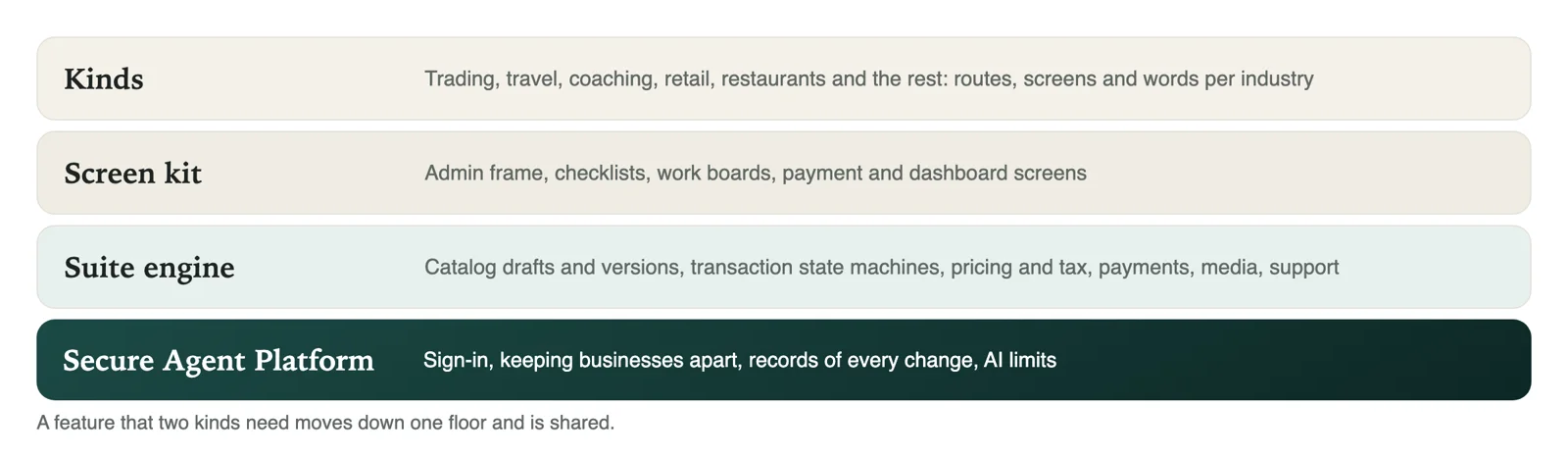
The software has four floors. Kind profiles (trading, travel, coaching, retail and the rest) sit on a shared screen kit (Admin frame, checklists, work boards, payment and dashboard screens), which sits on a shared suite engine (catalog drafts and versions, transaction state machines, pricing and tax, payments, media, support), which sits on the Secure Agent Platform (sign-in, keeping businesses apart, records of every change, AI limits). The rule is simple: as soon as two kinds need the same feature, it moves down a floor and is shared, so every new kind starts with everything built before it.
Technology: TypeScript; Cloudflare Workers, the D1 database and R2 storage for the hosted edition, with a tested Amazon Web Services adapter; passkeys (WebAuthn), email codes and Google sign-in. A full automated test gate runs before every change, including attack tests: one business trying to read another's data, forged links, missing security tokens, and the same button pressed twice at once.
Principles
- Every kind on one engine. No industry is a special case in the core; differences live in kind profiles and country packs.
- The business owns its customers and data. Downloadable at any time, and kept even if the business pauses.
- Simple to run, deep when needed. Each screen shows the fact and one action; ERP depth appears only when a business turns it on.
- Honest pages. Times come from real settings, allergens are shown in full, and legal items such as tax lines and license numbers are locked.
- People approve, AI assists. Agents draft and suggest; people decide on anything that matters.
Questions a new reader often asks
Questions
Is Ebiz Suite only for shops or food businesses?
No. It is a general SME suite, with kind profiles for shops and e-Shops, restaurants and cafes, tuition and coaching, trading and wholesale, travel and tours, lodges and homestays, taxi and transport, exporters, and services and repairs, all on the same engine.
How is it different from an ERP like Odoo or SAP Business One?
It starts where an SME starts: online presence, transactions and payments on day one, set up in an afternoon. ERP depth is added module by module, and an existing ERP can be connected instead of replaced.
What does ebz.app have to do with Ebiz Suite?
ebz.app is the hosted edition: the service where a business signs up and runs on Ebiz Suite without installing anything. See it at ebz.app/au and ebz.app/sg.
Can it handle more than one branch or outlet?
Yes. A business can have several outlets or branches, and staff can be limited to their own branch.
Will AI act on its own?
No. AI collaborators prepare drafts; a person approves anything that sends, buys or changes a record, and every action is recorded.
Glossary
- SME: small and medium-sized enterprise.
- CRM: customer relationship management: customer history, follow-ups and support.
- ERP: enterprise resource planning: software linking sales, stock, purchasing and finance.
- Kind profile: an industry's screens, words, steps and starter data on the shared engine.
- Country pack: a country's tax, payment and legal rules, kept as checked data.
- Work board: a live screen showing transactions by stage for the team.
- Passkey: sign-in with fingerprint or face unlock; no password is stored.
- AI Agent Collaborator: an AI helper that drafts work beside the team and waits for approval.
*Companion articles: "ebz.app", the hosted edition, and "Secure Agent Platform", the foundation. All business names and figures in the examples are fictional. © 2026 Srini Ramakichenane, Singapore.*